

Aim
The predictive processing framework for sports aims to explain how performers – such as athletes, coaches, referees, and other stakeholders – function and optimise outcomes in dynamic sporting environments.
The Framework
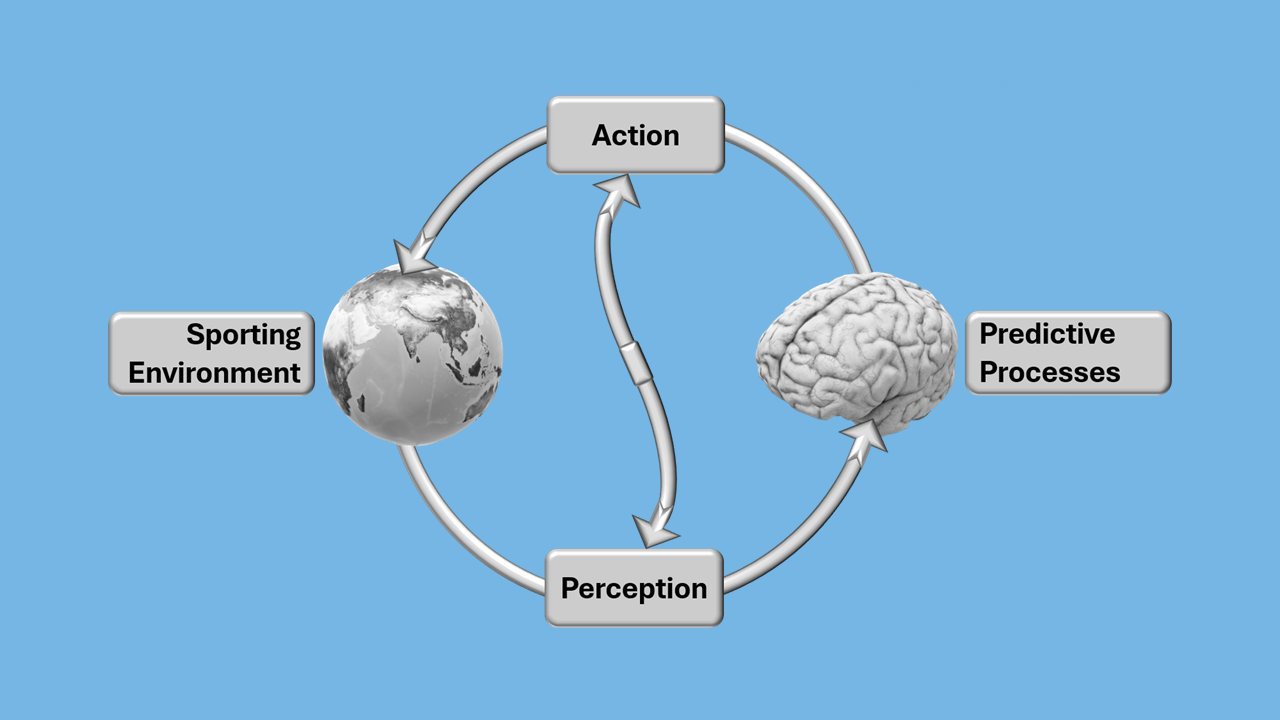
The framework proposes that performers continuously engage in adaptive exchanges with the sporting environment in which they operate. They produce actions to influence the sporting environment (and attain desired outcomes) whilst perceiving sensory information from the environment.
These continuous cycles of action and perception provide many benefits for meeting the challenges of a competitive and ever-changing environment (e.g., adaptive behaviour). However, the framework suggests that understanding how performers operate and navigate within the performance space also requires an explanation of what is happening internally for the performer and externally in the sporting environment.
Predictive Processing Framework for Sports
The Performance Space
The performance space comprises three integrated yet conceptually distinct aspects of the performer-environment dynamic:
1. The performer’s internal predictive processes,
2. The external sporting environment, and
3. The performer’s action-perception cycles.
Predictive Processes
At the level of the brain, the framework recognises four internal predictive processes as being influential for sports performance:
-
Internal representations that reflect the performer’s understanding, belief, and expectations about how the performance space works and how they function within it.
-
Probabilistic-based inferences (or best guesses) about likely events and outcomes based on the performer’s understanding of sensory observations.
-
A cognitive imperative to minimise mismatches between predictions and ongoing observations.
-
The cognitive capacity to dial up or down the importance (or relevance) of sensory information and prediction error signals.
The story unfold such that the performer’s brain, through its sporting experiences, constructs internal models of the game, which reflect their understanding, beliefs, and expectations about how the performance space operates and how they can navigate within it.
The performer’s brain then uses these models of the game, along with their observations of the sporting environment, to generate predictions about what is likely to occur and how they can optimise outcomes in their situation. Importantly, the performer’s brain has an in-built preference for these predictions to be accurate, and thus continuously works to minimise mismatches between its predictions and ongoing observations (i.e., prediction error minimisation).
This prediction error minimisation process plays out whereby, whenever a mismatch between predictions and observations is detected, the performer’s brain produces an error signal and mobilises resources to minimise the mismatch - which can be achieved by updating predictions to better fit observations and/or taking action to change the situation. In comparison, when the performer accurately predicts what is likely to occur, operating in the performance space will seem easier (because no extra resources need to be mobilised than those expected for the task).
To add the final piece to this predictive puzzle, the performer’s brain also has the ability to ‘precision-weight’ (or more simply, dial up or down) the importance of the sensory information and prediction error signals it experiences. This capacity enables the performer to assign relevance to sensory experiences, distinguish between the important and unimportant sensory information (i.e., the signal and the noise), and to guide attention towards where it is needed (and away from distractions).
The Sporting Environment
The sporting environment is a vast landscape that contains the physical environment (e.g., the playing field, sporting equipment, the weather, and other performers), the performer’s body (e.g., bodily sensations and movements), and the socio-political-cultural climate (e.g., expectations, norms, and interpersonal dynamics). Broadly speaking, the information present within the sporting environment can be classified into one of two categories: observable and hidden elements.
Observable Elements
Observable elements refer to those sources of information in the sporting environment that can be perceived via the performer’s sensory processes. These observable elements typically include things performers can see, hear, touch, smell, and taste, such as player movements, equipment, communications, field conditions, and refreshments.
Hidden Elements
Hidden elements refer to those sources of information in the sporting environment that are present and influential but not perceived via the performer’s senses. These hidden elements (which are typically embedded in the performer’s model of the game) include things such as the norms, expectations, rules of play, and uncertainty.
Action-Perception Cycles
The performer’s internal predictive processes and the sporting environment are integrated via the mechanisms of influence, in which performers engage in actions to influence the sporting environment and are reciprocally influenced by the environment through the perception of sensory information. Within the performance space, the performer’s actions and perceptions function as two sides of the same coin, which aim to minimise prediction errors.
Actions
Actions (such as physical movements and communications) are considered the primary way in which the performer influences the sporting environment. To a certain extent, these actions are purposeful, goal-directed, and intended to help performers participate, compete, and influence the sporting environment in desired ways.
Perceptions
Reciprocally, perceptions are considered the primary way the environment influences the performer. In particular, these perceptions play a vital role in helping performers make sense of the current situation and predict possible opportunities for action.
Adaptive Control
Importantly, the predictive processing perspective suggests that obtaining optimal outcomes via action-perception cycles is not something that can be attained passively. Rather, performers must learn to optimise their outcomes by exerting adaptive control over these processes. In particular, by guiding their actions and attention in an intentional and purposeful manner.